
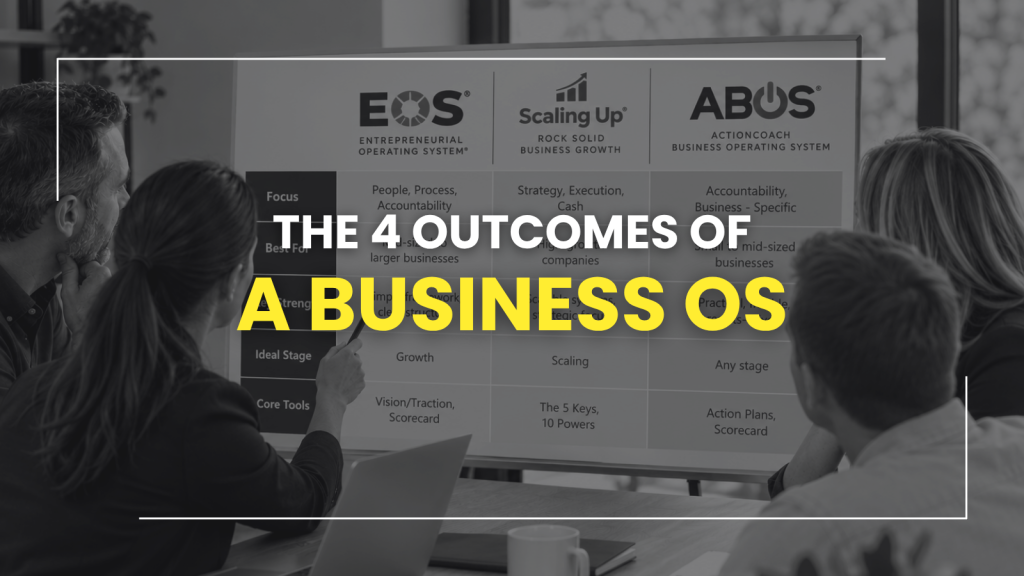
More and more growing companies are adopting a Business Operating System. Whether it’s EOS®, Scaling Up, ABoS (The ActionCOACH Business Operating System), or a custom-built internal framework, leaders are looking for structure to manage growth.
However, amidst all the terminology, weekly meetings, and scorecards, one critical question gets overlooked far too often:
What outcomes should your business operating system actually produce?
Ultimately, the value of any operating system isn’t found in its scorecards or meeting agendas, it’s measured strictly by the tangible results it delivers to your business.
When evaluating whether a system is truly serving your organization, see if it can deliver the following four outcomes:
1. Clarity
The first baseline test of any operating system is whether it establishes true organizational alignment.
- Vision & Direction: Does everyone know where the company is heading over the next 1 to 3 years?
- Leadership Alignment: Does your executive team fully agree on the vision, core goals, and current strategy?
- Immediate Focus: Does every individual on the team know what matters most right now?
If five members of your leadership team have five different ideas about the company’s top priorities, you lack clarity. Without total alignment at the top, execution across the rest of the company becomes extraordinarily difficult and expensive.
2. Execution
A strategic plan isn’t worth much if it gathers dust on a shelf. A great operating system bridges the gap between long-term vision and daily reality by operationalizing strategy into short-term execution rhythms.
It must systematically break multi-year targets down into manageable pieces:
- 90-Day Priorities: What critical goals must be accomplished in the next quarter?
- Weekly Action: What specific deliverables need to happen this week to stay on track?
- Ownership: Who is singularly accountable for each outcome?
- Measurement: How do we objectively know if an initiative is succeeding or failing?
3. Accountability
Assigning action items is only half the battle. The third essential outcome is building an environment where performance and commitments are completely transparent.
Does every team member know exactly which key performance indicators (KPIs) and business outcomes they own? Can the team easily see whether weekly commitments are being kept?
There is an important distinction here for effective leadership: Managers shouldn’t spend all their time trying to force accountability on people.
Instead, a business operating system should be designed to help people be accountable. When goals, expectations, metrics, and progress are openly visible to the whole organization, accountability becomes an automatic cultural norm rather than a managerial burden.
4. Improvement
This fourth outcome is the one that gets overlooked the most. Identifying that something is off-track is only step one; knowing how to fix it is where true growth happens.
Imagine your scorecard indicates that your sales conversion goal is 35%, but your actual metric is sitting at 22%. That data is valuable because it alerts you to a problem, but it leaves you with an obvious question: Now what?
Identifying a problem is not the same as knowing how to solve it.
A superior operating system shouldn’t just help you run the business you currently have, it must also give you the tools, problem-solving frameworks, and coaching methodologies to continually build a better business.
Auditing Your Operating System
Different operating systems achieve these four core outcomes in very different ways:
- EOS® is widely known for being effective at establishing clarity, execution, and basic accountability.
- ABoS delivers on those three fundamentals while placing a much heavier emphasis on continuous improvement, active coaching, and root-cause problem solving.
- Custom/In-House Systems can also work well, provided they aren’t omitting key operational disciplines.
Ultimately, the right system isn’t whichever one has the biggest brand name or the flashiest terminology. The right system is simply the one that produces the outcomes your specific business requires.
Take Action with Your Team
Take a few minutes during your next leadership meeting to run a quick audit. Ask your team four simple questions:
- Are we getting 100% clarity across our team?
- Are we executing on our strategic goals consistently?
- Have we built a system that makes accountability seamless?
- Are we continually improving our underlying business results?
Your answers will tell you everything you need to know about whether your current operating system is actually working for you, or if it’s time to install a better solution.
Author: Mark McNulty, Business Coach in Louisville, KY